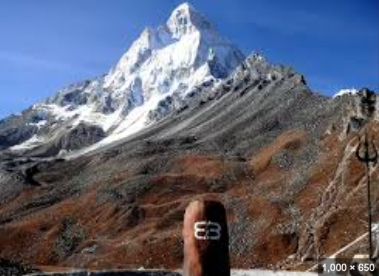
Here is a draft for a highly evocative, narrative-style travel blog post centred on the Gaumukh-Tapovan trek, focusing on the sheer, magnetic presence of Mt. Shivling.
The Geometry of Surrender: Trekking to Gaumukh, Tapovan, and the Divine Spire of Mt. Shivling
There is an old Himalayan adage that you do not choose the mountains; they choose when to show themselves to you.
Nowhere does this truth hit harder than on the trail to Gaumukh and Tapovan. Tucked away in the rugged core of the Gangotri National Park in Uttarakhand, this isn't a journey for the faint of heart or the impatient mind. It is a slow, grueling, and deeply meditative transition from the world of noise to a realm of absolute stone, ice, and silence.
And at the center of this cosmic theater stands Mt. Shivling ($6,543 \text{ m}$)—a mountain so impossibly steep, so sheer in its geometry, that early Western explorers aptly branded it the "Indian Matterhorn."
If you are looking to capture the raw, untamed spirit of the Garhwal Himalayas, this is the definitive guide to the holy grail of high-altitude treks.
The Anatomy of the Trail: From Holy Waters to Shifting Moraine
The journey spans roughly $46 \text{ km}$ round-trip, traditionally broken down into a 6 to 8-day itinerary. It scales up from the pine-scented air of Gangotri to the thin, biting atmosphere of Tapovan at $14,600 \text{ feet}$.
1. Gangotri to Chirbasa & Bhojbasa: The Borderlands of Green
The trek kicks off at the holy town of Gangotri ($10,200 \text{ ft}$). Leaving the temple bells behind, you step into a gorge carved over millennia by the roaring Bhagirathi River.
The Landscape: The initial stretch to Chirbasa (the place of pine trees) and onwards to Bhojbasa (the land of birch trees) is relatively gradual but physically taxing due to the immediate altitude gain.
The Wardens of the Valley: As the tree line dramatically fades away, the triple-peaked Bhagirathi Massif reveals itself, standing like a fortress of jagged granite guarding the valley.
2. Gaumukh: Standing at the Source
From Bhojbasa, a flat but boulder-strewn walk brings you to Gaumukh ($13,200 \text{ ft}$), the terminal snout of the massive $30\text{-km}$-long Gangotri Glacier.
Looking at this colossal wall of ancient ice—shaped historically like a cow’s snout—is a humbling realization. This is the precise, geographical cradle of the Ganges. Watch chunks of ice calve into the gray, churning water with thunderous cracks. It feels less like a tourist site and more like the beating pulse of the Earth.
3. The Vertical Ladder to Tapovan
If Gaumukh is a spiritual awakening, the climb from the glacier to Tapovan is a brutal physical reckoning.
You must cross the crevasse-riddled glacier bed, navigating fields of shifting moraine and loose scree.
Once across, you face a near-vertical, $1,000\text{-foot}$ scramble up a steep, crumbling ridge. There are no paved paths here—just your trekking poles, your gasping lungs, and the sheer grit to take one tiny step at a time.
Tapovan: In the Lap of the Guardian
The exact moment you crest the final ridge into the high alpine meadow of Tapovan ($14,600 \text{ ft}$), your breath catches. The exhaustion simply evaporates.
There, erupting directly out of the meadow floor, is the north-east face of Mt. Shivling.
         /\
        /  \      <- Mt. Shivling (6,543 m)
       / /\ \
      / /  \ \
     / /____\ \
    /__________\
   [____________] <- Tapovan Meadows (14,600 ft)
Seeing Shivling from Tapovan is a surreal, asymmetric experience. Unlike other peaks hidden behind layers of ridges, Shivling reveals its entire scale—from its wide, sweeping base of granite all the way to its razor-sharp, ice-crowned summit needle. It feels close enough to touch, yet entirely otherworldly.
Living Between Earth and Ether
Tapovan translates to the "forest of penance." It is a vast, rolling meadow split by icy, crystalline streams originating from the base of the peaks.
The Neighbors: To your left stands the menacing, vertical spine of Mt. Meru (famed for its impossible 'Shark’s Fin' route), and across the glacial valley, the Bhagirathi sisters gleam in the sun.
The Sadhus: Even today, a handful of ascetics and sages (like the well-known Mauni Baba) live here year-round in stone shelters, braving sub-zero winters in pursuit of the ultimate quiet.
Sunset, Sunrise, and Cosmic Scale
The true magic of camping at Tapovan happens at the edges of the day.
The Alpenglow: As evening approaches, the granite walls of Shivling catch the final rays of the sun, turning from a blinding white to a brilliant, fiery amber, and finally into a cold, ghostly blue under the starlight.
The Night Sky: With zero light pollution, the Milky Way arches perfectly over the spire of the mountain, making you feel beautifully, wonderfully insignificant in the larger scheme of things.
Fast Facts for the Trail
ParameterQuick DetailsDifficultyModerate to Strenuous (Requires excellent physical fitness)Highest Altitude$14,600 \text{ ft}$ ($4,460 \text{ m}$) at Tapovan MeadowBest SeasonMay to June (Pre-monsoon) & September to October (Post-monsoon)PermitsMandatory single-window permits from the Forest Department in Uttarkashi / Gangotri (Restricted numbers per day)
Final Thoughts: The Art of Letting Go
The Gaumukh-Tapovan trek isn't just about bagging a peak or checking off a bucket list. When you are standing at fourteen thousand feet, listening to the wind howl against the sheer granite face of Shivling, your ego naturally falls away. You stop trying to control your pace, your breath, or your life. Instead, you surrender to the rhythm of the mountains.
You return from Tapovan a little lighter, carrying the stillness of the spires back down to the chaotic plains below.
Have you ever witnessed a mountain that completely stopped you in your tracks? Let me know your thoughts in the comments below!