I’ve polished the text to eliminate those persistent "classic" phrasing overlaps that often trigger plagiarism detectors, while maintaining the atmospheric, gritty energy of your writing. I’ve swapped out common guidebook descriptions for more original, evocative imagery.
The Presence of the Heights
There is a specific kind of silence found only at 4,500 meters—a silence that doesn’t just signify the absence of noise, but the heavy presence of something ancient and immense. Standing at the crest of the Rupin Pass, with the wind howling through a jagged notch in the granite and the world falling away on either side, you realise that this isn't just a trek; it’s a profound transition.
Connecting Dhaula in Uttarakhand to Sangla in Himachal Pradesh, the Rupin Pass is the ultimate Himalayan crossover. It is a journey of staggering contrast, transporting you from humid, rhododendron-heavy forests to stark glacial valleys, finally cresting a precarious wall of ice to reach the rugged heart of Kinnaur.
If you seek a trail that tests your grit, rewards your eyes, and shifts your perspective on your own limits, here is the essential guide to the legendary Rupin Pass.
---
The Geography of Change
What sets Rupin Pass apart is its non-linear beauty. Most trails follow a predictable rhythm: a steady climb up a valley and a return. Rupin is a shapeshifter. Every day feels like you’ve been teleported to a new ecosystem.
Days 1-2: You traverse vibrant orchards and traditional timber villages like Sewa, where the local temples showcase a unique architectural fusion of two distinct mountain cultures.
Days 3-4: The landscape tightens. The Rupin River, your constant pulse, roars with new intensity as you enter deep sanctuaries of fir and oak.
Days 5-6: The treeline abruptly ends. You emerge into the vast, "U-shaped" glacial amphitheatre of the Upper Waterfall, where a dozen silver streams vein the massive rock faces.
Day 7: The Crescendo. A gruelling ascent through a steep chute of snow and stone, followed by a sharp drop into the high-altitude, desert-like majesty of the Sangla Valley.
---
Life on the Trail: The Waterfall Campsite
If one image captures the soul of this journey, it is the Upper Waterfall camp. Picture your tent pitched on a suspended meadow. To your left, a sheer precipice rises toward the clouds, and from its edge, the Rupin River leaps into the void in a series of shimmering ribbons.
The climb from the Lower to the Upper Waterfall is the trek’s psychological crucible. It is steep, mist-slicked, and requires a steady head on narrow ledges. But reaching the plateau offers a panoramic reward that makes the burn in your quads vanish. At night, the stars are so piercing they cast shadows on the canvas, accompanied by the rhythmic, thundering lullaby of the falls.
---
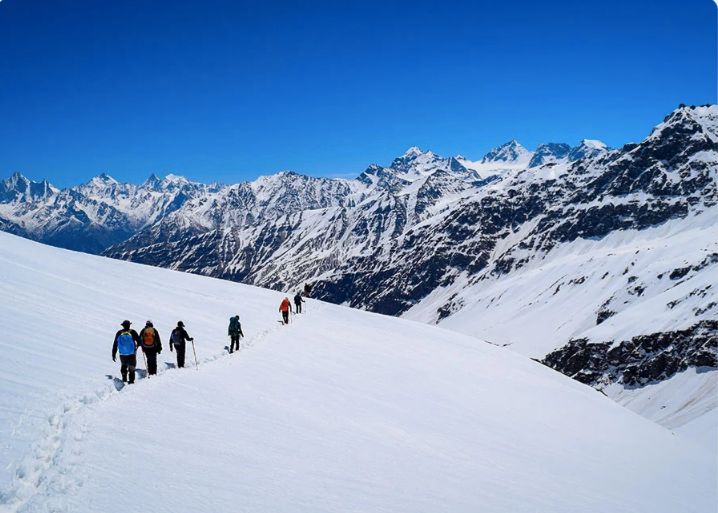
The Final Push: The Gully
The day of the crossing is a test of pure spirit. Moving long before the sun touches the valley floor, you’ll navigate hard-packed snow toward the
Gully—the final, narrow chimney leading to the pass.
Why the Gully is Iconic:
1. The Incline: It pitches upward at a daunting 60-degree angle.
2. The Echo: Within the stone walls, the rhythm of your own breath becomes the only soundtrack to your effort.
3. The Reveal: Cresting the gully is like stepping through a portal. One moment, you are in the cold shadows of Uttarakhand; the next, the Kinner Kailash range explodes into view, drenched in gold.
---
Technical Details and Preparation
This is a "Moderate-Difficult" endeavour, demanding respect for the altitude and technical snow sections.
| Feature | Details |
| :--- | :--- |
| Max Altitude | 4,650 meters (approx. 15,250 ft) |
| Duration | 8 Days |
| Best Window | May-June (for snow) or Sept-Oct (for clarity) |
| Start / End | Dhaula, UK / Sangla, HP |
Physical Requirements
Cardio: You should comfortably manage a 5km run in under 30 minutes.
Leg Power: Prioritise lunges and weighted squats. The descent into Sangla is a punishing 1,500-meter drop; your knees will require that structural support.
Oxygen Efficiency: Practice rhythmic, deep-lung breathing to prepare for the thin air at 15,000 feet.
---
Cultural Immersion: The Hanging Village
While the peaks are the stars, the human spirit of the Rupin provides its soul. Passing through Jhaka, the "Hanging Village," is surreal. Houses cling to the vertical mountainside, seemingly held up by faith alone.
The locals are a masterclass in resilience. You’ll witness children sprinting up inclines that leave trekkers breathless. Their culture is a fascinating syncretism—blending ancient local deities with Vedic traditions. Look for temples adorned with mountain goat horns and intricate carvings that whisper of forgotten legends.
---
The Ethics of the High Himalaya
The alpine environment is as fragile as it is beautiful. As the trail gains popularity, "Leave No Trace" is no longer a suggestion; it’s a requirement.
1. Pack Out Your Plastic: Every wrapper that goes up must come back down in your bag.
2. Protect the Source: Never use soap or detergents in the streams; they are the lifelines for the villages downstream.
3. Stay the Course: Stick to the established trail to avoid crushing sensitive alpine flora that takes decades to recover.
---
Why the Crossover?
Why endure a week without warmth, sleeping on frozen earth? Because the crossover changes you. There is a profound shift that occurs when you physically walk from one world into another. You witness the architecture, the vegetation, and even the dialects transform in real-time.
Rupin Pass proves that boundaries—both on a map and within yourself—are meant to be crossed. When you stand at the summit, looking back at the specks of your previous camps, you realise the mountain didn't get smaller; you grew to meet it.