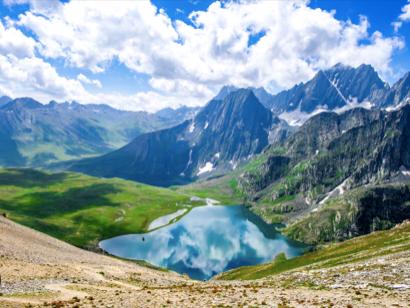
There is a reason the Kashmir Great Lakes (KGL) Trek is widely considered the most beautiful trek in India. It is not just the high-altitude thrills; it is the sheer, overwhelming scale of visual drama.
JustWravel
Over the course of roughly 7 to 8 days and 74 kilometres, the landscape shifts from aromatic pine forests to endless, vibrant green meadows, eventually opening up to pristine, turquoise alpine lakes that feel entirely cut off from the modern world.
Wildcraft
If you are looking to step into a living watercolour painting, here is your definitive guide to the KGL trek.
Here is the snapshot table converted into simple text form:
Trek: Kashmir Great Lakes (KGL) Trek
Start / End Point: Sitkadi (Sonamarg) to Naranag
Total Distance: approximately 74 kilometres (46 miles)
Maximum Elevation: 13,800 feet (4,206 meters) at Gadsar Pass
Difficulty Level: Moderate to Difficult
Best Time to Visit: July to early September (Monsoon season)
A True Monsoon Trek: Unlike the rest of India, where monsoons mean the Pir Panjal range partially shields dangerous landslides and muddy washouts, the Kashmir valley. The rain here turns the meadows into an explosion of wild alpine flowers like daisies and blue poppies.
The Master Itinerary: Day-by-Day
The beauty of the KGL trail is its daily reinvention. You don't just hike to one viewpoint; every single day introduces a completely new valley, a challenging new pass, and a different collection of glacial lakes.
JustWravel
1-
Srinagar to Sonamarg (Drive)
Day 1 • 3 hours
The journey begins with a scenic drive from Srinagar to the base camp at Sitkadi (near Sonamarg). Use this evening to pitch your first tents, test your gear, and let your body start adapting to the crisp mountain air at 8,990 ft.
2-
Sitkadi to Nichnai via Shekdur
Day 2 • 11 km • 8 hours
Your first true trekking day features a steady climb through dense birch and pine forests before opening up into the vast meadows of Shekdur. You'll camp tonight at Nichnai, a rocky valley flanked by jagged peaks.
3-
Nichnai to Vishansar Lake via Nichnai Pass
Day 3 • 13 km • 7 hours
You will conquer your first major pass today: Nichnai Pass (13,225 ft). The steep, rocky ascent rewards you with an immediate, jaw-dropping descent into lush grasslands that lead straight to the mesmerising, deep-blue Vishansar Lake.
4-
Vishansar to Gadsar via Gadsar Pass
Day 4 • 14 km • 8 hours
This is the toughest yet most rewarding day. You'll pass the twin Krishansar Lake before ascending the highest point of the trek: Gadsar Pass (13,800 ft). From the top, you get a bird's-eye view of both lakes before dropping down past the pristine, isolated Gadsar Lake (often called the Lake of Flowers).
5-
Gadsar to Satsar
Day 5 • 12 km • 6 hours
The trail transitions into a slightly rugged, boulder-strewn landscape. Satsar translates to "seven lakes"—a network of interconnected alpine tarns tucked inside a narrow valley, often shared with local nomadic shepherds (Gujjars).
6-
Satsar to Gangabal & Nundkol Lakes
Day 6 • 11 km • 6 hours
After navigating a massive boulder zone, you'll reach the ridge of Zaj Pass. From here, the twin spectacles of Gangabal and Nundkol Lakes reveal themselves, sitting dramatically beneath the massive, snow-draped rock face of Mount Haramukh.
7-
Gangabal to Naranag & Departure
Day 7 • 13 km • 6 hours
The final stretch is a long, knee-jarring descent through golden meadows and thick pine forests. The trail drops down into the ancient village of Naranag, where you can explore its historic stone temple ruins before catching a vehicle back to Srinagar.
Why This Trek Demands Your Respect
It’s easy to get lost in the romance of the photos, but KGL is physically demanding.
The Constant Rollercoaster: Unlike treks that feature a single long climb and a single long descent, KGL forces you to cross a massive mountain pass and drop into a new valley nearly every single day. Your knees and lungs will feel every bit of it.
JustWravel
The High Altitude: Spending multiple days sleeping above 11,000 feet requires good lung capacity.
How to Train for KGL
If you want to enjoy the views rather than gasp for air the whole time, start your physical preparation at least two months in advance. Focus on cardiovascular endurance (aim to run 5 km in under 35 minutes) and leg strength (stair climbing and weighted squats are your best friends).
Essential Packing Checklist
Because you are entering pristine, high-altitude terrain with absolutely zero electricity or mobile connectivity, packing smart is vital.
Footwear: Ankle-high trekking shoes with deep grooves. Ensure they are well broken-in before the trek to avoid blisters on the boulder fields.
Layers are King: The weather in the alpine valleys is wildly unpredictable. Pack 3–4 layers: moisture-wicking t-shirts, a warm fleece layer, a down jacket for freezing nights, and a high-quality waterproof poncho.
Himalayan Hikers
Gear: A sturdy pair of trekking poles (non-negotiable for the steep descents) and a reliable power bank to keep your camera alive.