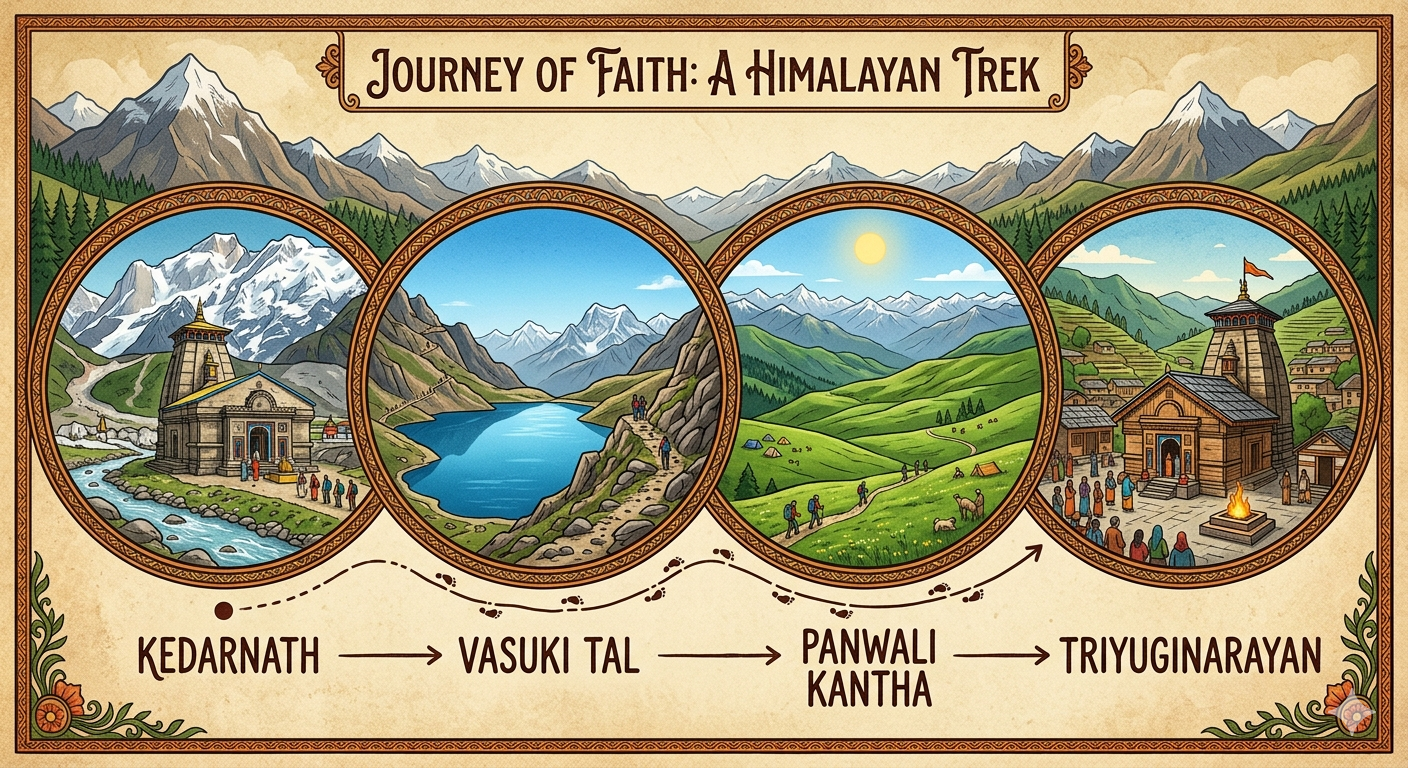
The locations you mentioned—Bhairav Nath Temple, Vasuki Tal, and Triyuginarayan Temple—can be linked into a multi-day high-altitude crossover trek centred around Kedarnath.
The Kedarnath Trek is the most visited.
While most pilgrims visit these as separate day trips or extensions, experienced trekkers often connect them via the Mayali Pass or the ancient Kedarnath-Triyuginarayan trail.
1. The Core Crossover: Kedarnath to Triyuginarayan
Historically, this was the primary route used by pilgrims before the motorable road to Gaurikund was built. It is a stunning 25–28 km crossover that avoids the crowded main trek.
Route: Kedarnath → Vasuki Tal → Panwali Kantha (optional) → Triyuginarayan.
The "Secret" Path: There is a direct old trail from Kedarnath to Triyuginarayan that stays on the ridge. However, most modern "crossovers" go from Kedarnath to Vasuki Tal and then descend towards Triyuginarayan via the high-altitude meadows (bugyals).
Highlight: Triyuginarayan is where Lord Shiva and Goddess Parvati were married; an eternal flame has been burning there for centuries.
2. High-Altitude Link: Vasuki Tal (4,135m)
Vasuki Tal is an 8 km trek from Kedarnath. For a crossover, this lake serves as the gateway to the Mayali Pass Trek.
The Link: From Vasuki Tal, you can cross the Mayali Pass to reach Ghuttu and eventually Reeh/Gangi.
Terrain: This is a difficult section involving glacier crossings (Chaturangi and Vasuki Glaciers). It is not a standard pilgrim path and requires a local guide and technical gear.
3. The Spiritual Extension: Bhairav Nath Temple
Location: 500 meters to 1 km uphill from the main Kedarnath Temple.
The Link: Every visitor to Kedarnath is expected to visit Bhairav Nath, as he is considered the "Kshetrapal" (protector) of the valley when the temple closes for winter. It offers the best panoramic view of the entire Kedarnath shrine and the trail coming up from Linchauli.
Suggested "Grand Crossover" Itinerary (5–6 Days)
If you want to link all these specifically, here is the logical progression:
Day Destination Details
Day 1 Sonprayag to Triyuginarayan A short 5 km warm-up trek (or drive) to the wedding temple.
Day 2 Triyuginarayan to Maggu Chatti Trek through dense forests and meadows. This is the start of the old pilgrim trail.
Day 3 Maggu Chatti to Kedarnath A long, challenging day crossing a ridge to descend into the Kedarnath valley.
Day 4 Kedarnath & Bhairav Nath Morning Darshan at Kedarnath, followed by a 1 km climb to Bhairav Nath Temple for the views.
Day 5 Kedarnath to Vasuki Tal 8 km steep ascent to the crystal-clear lake. Return to Kedarnath or camp (if equipped).
Day 6 Kedarnath to Gaurikund Descend via the main 16 km pilgrim route to conclude.
Technical Notes for Your Planning:
Best Time: May–June and September–October.
Guides: While the route to Bhairav Nath and Triyuginarayan is manageable, Vasuki Tal and the crossover sections require a guide due to tricky glacier moraines and a lack of clear signposting.
Permits: You must register for the Kedarnath Yatra on the official Uttarakhand Tourism portal, especially if you plan to stay overnight at the temple base camp.