Crossing Worlds: The Definitive Guide to the Pin Bhaba Pass Trek
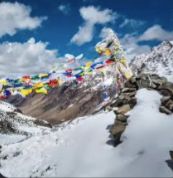
Imagine standing on a jagged mountain spine where the horizon is split in two. Behind you lies a velvet-green sanctuary of ancient forests; ahead, a desolate, crimson-hued moonscape stretches toward the horizon. This is the Pin Bhaba Pass, famously dubbed the "Great Crossover" for its surreal transition between two opposing worlds.
This expedition bridges the gap between the rain-fed, lush valleys of Kinnaur and the high-altitude, arid wilderness of Spiti. For those looking to graduate from beginner trails to true Himalayan exploration, this is your rite of passage.
🏔️ What Sets Pin Bhaba Apart?
Unlike most treks where landscapes shift subtly, Pin Bhaba offers a "cinematic reveal." You go from trekking through meadows that mimic the beauty of Kashmir to suddenly overlooking the stark, jagged sculptures of the Pin Valley National Park.
The Transformation: The journey begins in the Bhaba Valley, characterized by roaring rivers and vibrant flora, and concludes in Mudh, a Spitian outpost that feels like the very edge of the map.
The Summit: Reaching $4,915\text{ m}$ ($16,125\text{ ft}$) isn't just a physical feat—it's a front-row seat to a 360-degree collision of two distinct ecosystems.
🥾 Is This the Right Challenge for You?
The Pin Bhaba Pass is as demanding as it is beautiful. Here is the breakdown of what to expect:
FeatureDetailsDifficultyModerate to Difficult. Recommended for those with prior trekking experience.Duration8 to 9 days (Door-to-door from Shimla/Kaza).Peak Altitude$4,915\text{ m}$ (roughly $16,125\text{ ft}$).Prime WindowMid-July to September. Since Spiti sits in a rain shadow, it's a rare safe haven during the Indian monsoon.Physical PrepHigh. You should be comfortable running $5\text{ km}$ in under 30 minutes.
Peer Advice: If you are a complete novice, you might want to tackle the Hampta Pass first. It provides a similar "green-to-brown" crossover but with less intensity.
📍 The Route at a Glance
Kafnu: The gateway in Kinnaur. Getting here is an adventure in itself, involving roads carved directly into the Himalayan granite.
Mulling & Kara: The "Green Zone." Expect expansive pastures, nomadic shepherds, and the constant soundtrack of the Bhaba River.
Phustirang: The high-altitude basecamp. It is stark, chilly, and serves as the literal launching pad for the pass crossing.
The Great Crossing: Usually a pre-dawn start ($3:00\text{ AM}$). You’ll navigate steep scree slopes and permanent snow patches where the air grows noticeably thin.
Mudh Village: The finish line. A starkly beautiful Spitian village with white-washed homes and a deep sense of Tibetan Buddhist peace.
⚠️ Essential Strategy for the Trail
Respect the Altitude: The climb starts aggressively with an $850\text{ m}$ gain on the first day. Don't skip your acclimatization drills.
Layering is Non-Negotiable: Even in the height of summer, the mercury can plummet to $-5^\circ\text{C}$ after sunset.
Keep Your Feet Dry: You will encounter multiple glacial stream crossings. Invest in high-quality waterproof boots; wet feet in the high Himalayas can end a trek prematurely.
The Pin Bhaba Pass isn't just a path between two valleys; it is a bridge between two different Himalayan souls.
What does your current fitness routine look like, or do you have a specific trekking history we should consider?