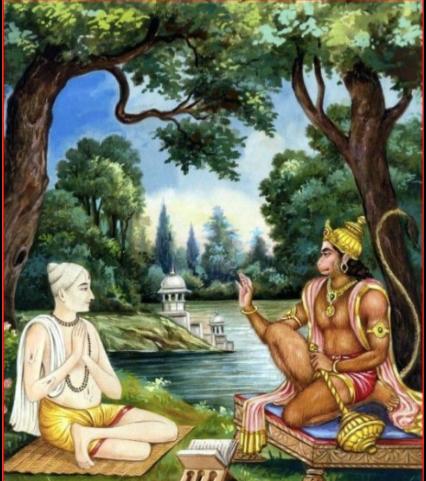
हनुमान चालीसा की रचना महान संत और कवि गोस्वामी तुलसीदास ने की थी। उन्होंने 16वीं शताब्दी में अवधी भाषा में भगवान हनुमान की स्तुति में इन चालीस चौपाइयों को लिखा था.
In Hindu tradition, Lord Hanuman is revered as Ashta Siddhi Nav Nidhi Ke Data (the bestower of the eight supernatural powers and nine types of wealth), a blessing granted to him by Goddess Sita.
The Ashta Siddhi refers to the eight distinct occult or divine powers (siddhis) that Hanuman possesses. These powers allow him to manipulate physical matter, size, weight, and space at will.
The Eight Siddhis of Hanuman
1. Anima (Shrinking): The power to reduce one's body to the size of an atom or a speck.
>Example: Hanuman used this to enter Lanka undetected by shrinking himself to the size of a mosquito to slip past the demoness Surasa and the guard Lankini.
2. Mahima (Expanding): The power to grow infinitely large, scaling up to a colossal, cosmic size.
> Example: He assumed a gigantic form to cross the ocean to Lanka in a single leap, and again when displaying his Vishwaroopam (cosmic form) to instil fear in Ravana's court.
3. Garima (Becoming Heavy): The power to increase one's weight infinitely, making oneself completely immovable.
> Example: Hanuman used this to humble Bhima in the Mahabharata. He disguised himself as an old monkey and laid his tail across the path; Bhima, proud of his immense physical strength, could not lift Hanuman's tail even an inch.
4. Laghima (Becoming Light): The power to make the body weightless, lighter than air or a feather. This power allows for flight and effortless levitation.
> Example: Hanuman used Laghima along with Mahima to fly across the ocean to Lanka and to carry the entire Dronagiri mountain back to the battlefield.
5. Prapti (Omnipresence / Attainment): The ability to instantly travel anywhere at will, access any realm (including the underworld or heavens), and acquire whatever he desires. It also gives him the power to understand the languages of all living beings.
6. Prakamya (Irresistible Will): The power to achieve or experience absolutely anything he wishes, or to adapt to any environment perfectly. For instance, it allowed him to survive deep underwater or enter the fiery atmosphere of the sun without harm.
7. Ishitva (Lordship / Supremacy): The power of absolute lordship over nature, elements, and other beings. This divine majesty allows him to command the laws of physics and influence creation.
8. Vashitva (Subjugation / Control): The power to tame, control, and completely influence others, including wild animals, demons, and human minds. It is the ultimate form of absolute self-restraint and external control.
These eight powers make Hanuman virtually invincible, yet in the scriptures, he is celebrated most because he rarely used them for personal gain—only in the selfless service of Lord Rama.
Exactly!
Those are the eight supernatural powers (Ashta Siddhi).
The second half of that famous blessing given to Lord Hanuman is the Nav Nidhi—the nine treasures of Kubera (the god of wealth).
While the Siddhis represent inner spiritual and physical mastery, the Nidhis represent different forms of material wealth, prosperity, and cosmic energies. Each treasure is personified as a mystical entity or gemstone:
The Nine Treasures (Nav Nidhi)
1. Mahapadma (The Great Lotus): Symbolises immense wealth, clean assets, and boundless prosperity. It represents inherited riches that have been passed down through generations and remain stable.
2. Padma (The Lotus): Associated with massive spiritual and material fortune. It represents wealth gained through righteous means, marked by clouds, gold, and silver. A person blessed with this is said to be highly charitable.
3. Shankha (The Conch): Represents wealth coupled with victory and fame. It is a treasure enjoyed self-sufficiently, though it can sometimes make a person self-reliant to the point of isolation.
4. Makara (The Crocodile): Symbolises weapon-based strength, royal favour, and the collection of fine arts, gems, and armour. It represents an increase in external power and influence.
5. Kachhapa (The Tortoise): Represents self-contained, securely guarded, and hidden wealth. Just like a tortoise draws its limbs into its shell, this treasure signifies massive assets that are kept private and safe from the outside world.
6. Mukunda (The Quick Silver / Lily): Represents fine, consumable wealth—luxury, fine dining, literature, music, and royal pleasures. It is the joy of spending wealth on an aesthetic life.
7. Kunda (The Jasmine / Oleander): Associated with trade, barter, and precious metals like gold. It signifies smooth business dealings and resource accumulation.
8. Nila (The Sapphire): Represents liquid assets, constant trade, and dynamic wealth that keeps moving. It is also linked to luxury textiles, clothing, and grain storage.
9. Kharva (The Dwarf / Mixed Treasure): The final crowning treasure. It represents the accumulation of miscellaneous riches, coins, and physical properties. It also brings the humility needed to hold all the other treasures without letting ego take over.
🙏🏻