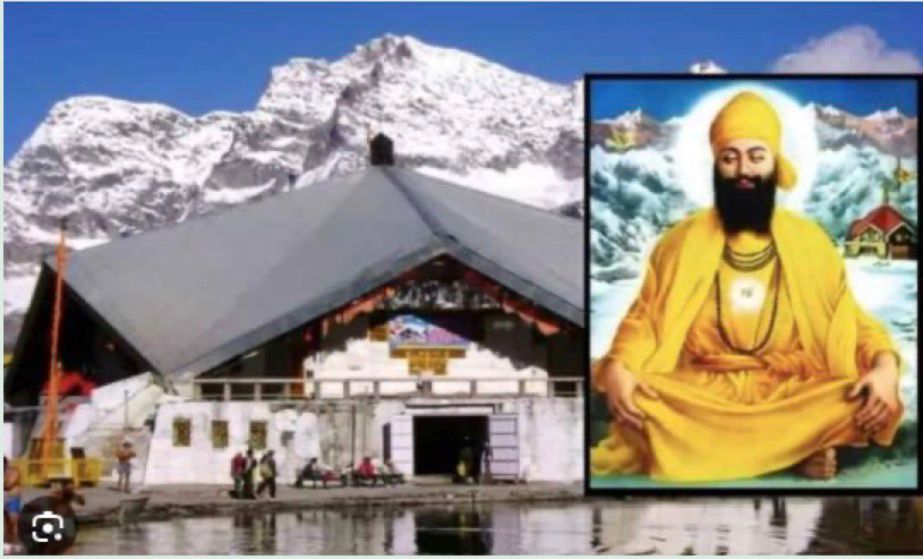
The Stairway to Serenity: An In-Depth Guide to Sri Hemkund Sahib Ji
Perched at a staggering altitude of 15,225 feet (4,632 meters) in the Garhwal Himalayas, Sri Hemkund Sahib Ji is more than just a pilgrimage; it is a profound intersection of natural grandeur and spiritual devotion. For many, the journey to this glacial lake is a "once-in-a-lifetime" calling—a physical manifestation of the soul's ascent toward the divine.
The Sacred History: From Meditation to Discovery
The spiritual foundation of Hemkund Sahib is rooted in the Dasam Granth. In the composition Bachitar Natak, Guru Gobind Singh Ji describes his previous incarnation as the sage Dust Daman, who performed intense penance at a place surrounded by seven snow-clad peaks, known as Sapt Shring.
For centuries, the location remained a mystery, tucked away in the inaccessible heights of the Himalayas. It wasn't until the early 20th century that Sant Sohan Singh and Havildar Modan Singh identified the site based on the Guru's descriptions. Today, it stands as the highest Gurudwara in the world, symbolizing the triumph of spirit over the physical world.
The Trek: A Path of Perseverance
The journey to Hemkund Sahib is a 19-kilometer spiritual odyssey that begins at the town of Govindghat.
Phase 1: Govindghat to Ghangaria (13 km)
The first leg follows the Lakshman Ganga River. The path is well-paved but involves a steady incline. As you walk, the air turns crisper, and the roar of the river provides a constant, rhythmic backdrop. Ghangaria, a small hamlet, serves as the base camp where pilgrims rest before the final ascent.
Phase 2: The Steep Ascent (6 km)
This is where the true test begins. The 6-kilometer stretch from Ghangaria to the holy shrine is a series of steep switchbacks. As the oxygen levels drop, every step requires conscious effort.
The Experience at the Summit
Reaching the top is an sensory explosion. The sight of the star-shaped Gurudwara—designed by Architect M.S. Siali to withstand the weight of 30 feet of snow—reflected in the emerald waters of the Hemkund Sarovar is breathtaking.
The Holy Dip: Despite the freezing temperatures, pilgrims take a dip in the Sarovar. It is believed to cleanse the soul and rejuvenate a tired body.
The Ardas: Inside the Gurudwara, the atmosphere is thick with devotion. The chanting of Gurbani amidst the silence of the peaks creates a meditative state that many describe as "otherworldly."
Laxman Temple: Adjacent to the Gurudwara is a small temple dedicated to Lord Laxman, signifying the deep-rooted multi-faith harmony of the region.
Practical Guide for the Modern Pilgrim
Category
Advice & Requirements
Best Window
June to early October. The shrine closes during the winter months due to heavy snow.
Physical Prep
Start cardio exercises (walking/running) at least a month before the trip.
Oxygen
Carry small portable oxygen canisters if you are prone to altitude sickness.
Permits
Check for current Uttarakhand state registration (Chardham Yatra portal) requirements.
Export to Sheets
Preserving the Sanctity
The Himalayan ecosystem is fragile. As a visitor, the greatest "Prasad" you can give back is to leave the mountains as you found them.
Avoid single-use plastics.
Use the trash bins provided along the route.
Respect the silence of the high-altitude silence.
Sri Hemkund Sahib Ji is not just a destination; it is a reminder that the most beautiful views—and the deepest peace—are reserved for those willing to climb the hardest.