The Spiritual Heart of South Delhi: A Guide to Shri Kalkaji Mandir
Nestled in South Delhi, right across from the bustling commercial hub of Nehru Place, lies a sanctuary that has drawn seekers, saints, and travelers for millennia: Shri Kalkaji Mandir. Dedicated to Goddess Kali (affectionately known as Kalka Maa), this temple is one of the oldest and most revered shrines in India.
Whether you are seeking spiritual solace, a deeper look into Delhi’s ancient history, or just want to experience the electric energy of a traditional Indian pilgrimage site, Kalkaji Mandir is a must-visit.
The Legends: A Shrine Born in the Satya Yuga
According to local folklore and ancient texts, the sacred ground of Kalkaji dates back over 3,000 years to the Satya Yuga (the Era of Truth).
The Emergence of Maa Kali: Legend has it that two powerful demons, Raktabija and Shumbha-Nishumbha, were terrorizing the gods. Seeking protection, the deities prayed to Goddess Parvati. From her divine form emerged Goddess Kaushiki, and subsequently, the fierce Goddess Kali, who defeated the demons and drank Raktabija's blood before it could touch the earth and multiply. At the gods' request, she chose this very hill as her eternal abode.
The Pandavas' Prayer: The temple finds a mention in the epic Mahabharata. It is believed that Lord Krishna and the Pandavas visited this hill during their exile to worship Kalka Maa, seeking her blessings and courage before going to war.
Because the central idol of the Goddess is believed to be Swayambhu (self-manifested), the shrine is revered as a Manokamna Siddha Peeth—a holy place where pure-hearted desires are directly fulfilled.
A Walk Through History and Architecture
While the roots of the temple are ancient, its physical structure tells a story of survival, resilience, and multi-era architecture.
The core structure standing today was primarily built in 1764 AD by the Marathas, who revived the site. Later, in 1816, Mirza Raja Kidar Nath (the treasurer to the Mughal Emperor Akbar Shah II) added finer touches and renovations to the complex.
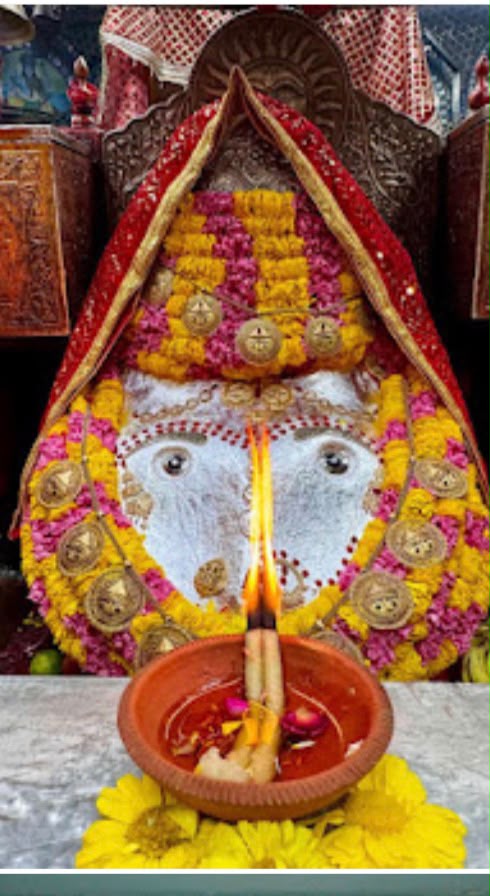
The temple features a unique 12-sided central chamber built from brick masonry, plaster, and pristine white marble, topped with distinctive pyramidal towers. As you enter through the eastern doorway, you are greeted by two striking red sandstone tigers sitting on a marble pedestal, guarding the inner sanctum where the deity is adorned with red hibiscus flowers.
The Experience: Sounds, Sights, and Devotion
Visiting Kalkaji Mandir is an assault on the senses in the most beautiful way. The air is permanently thick with the fragrance of incense, camphor, and fresh marigolds.
The temple is closed on Mondays, but Tuesdays and Saturdays see incredible crowds of locals lining up to catch a glimpse (darshan) of the Goddess. The atmosphere reaches fever pitch during the bi-annual Navratri festivals (in Spring and Autumn). The entire complex lights up, devotional songs (bhajans) echo through loudspeakers, and a massive, vibrant fair (mela) springs up around the hill, selling everything from traditional handicrafts and cosmetics to piping-hot street food.